CONSENSUS// Feb 26, 2026// 10 min read
Decentralization by design: committees, quorum, and liveness
The Operatus Team
Protocol Research
Decentralization is often reported as a single number: how many validators does the chain have. That number matters, but it is not the whole story. What actually determines whether a chain stays safe and live is a set of concrete mechanisms: who gets to participate in each round, how many of them must agree, and what happens when some of them go missing. Design those well and a chain resists both capture and stalls. Design them poorly and a large validator count can hide a fragile core.
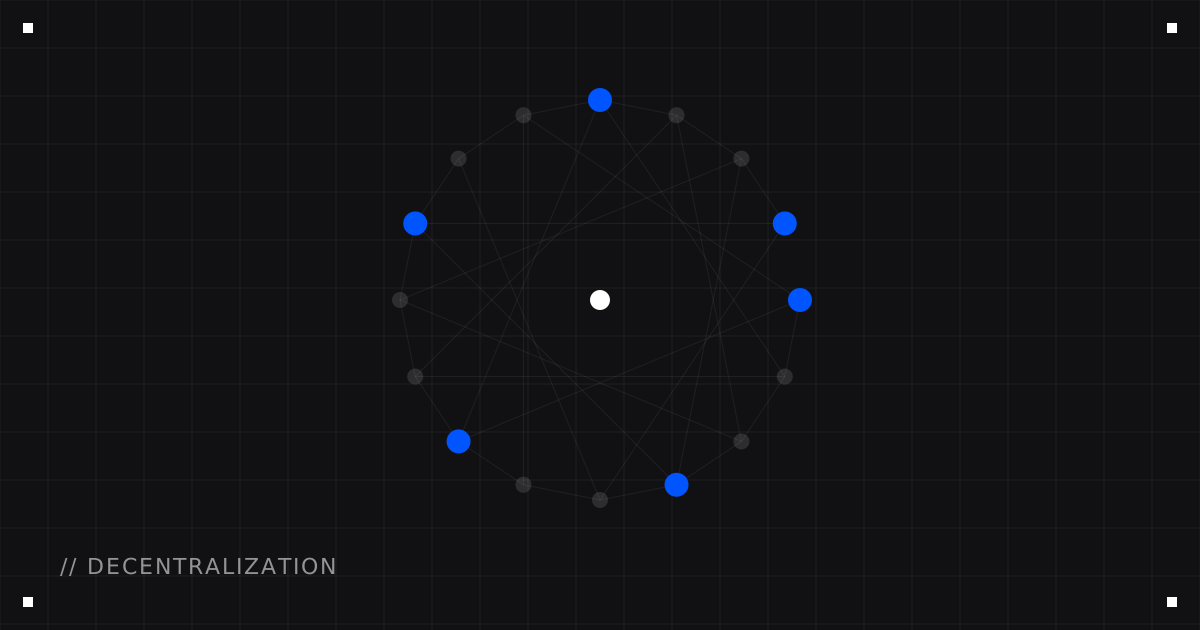
Not every consensus system asks every validator to vote on every block. Many use a committee: a subset of the validator set, selected for an epoch or a window, that carries out block production and finality voting. Committees keep consensus efficient, because coordination cost grows with the number of participants, and a smaller active committee finalizes faster than the entire set voting in lockstep.
The design tension is between efficiency and inclusion. Too small a committee concentrates power; too large a committee slows finality. The healthy pattern is a committee that is large enough to be hard to capture, rotates over time so participation is shared, and admits new bonded validators rather than freezing membership around an initial set.
A high validator count means little if the same handful always forms the committee. Decentralization lives in rotation and admission, not just in the size of the roster.
Quorum is the threshold of agreement required to finalize. In stake-weighted BFT-style finality, that threshold is more than two-thirds of the stake. This number is not arbitrary. It is the smallest fraction that guarantees safety when up to one-third of the stake is faulty or malicious: any two supermajorities must overlap in at least one honest participant, which prevents two conflicting blocks from both being finalized.
Stake-weighting the quorum is what ties economic security to consensus. An attacker cannot manufacture voting power by spinning up many small nodes; they would need to control more than a third, and eventually more than two-thirds, of the actual bonded capital. That capital is exactly what is at risk of being slashed. The math and the money point the same direction.
Safety says the chain never finalizes two conflicting histories. Liveness says the chain keeps making progress. These are different properties, and it is possible to preserve one while losing the other. A chain can be perfectly safe and completely stuck.
One common liveness hazard is the dead slot. In a slot-based system, each slot has an assigned author. If that author is offline, the slot produces no block, and the chain waits until the next reachable author's slot. A few dead slots are harmless. But if the schedule keeps assigning slots to validators that are dormant or unreachable, progress stutters. The fix is to build the proposer schedule from validators that are actually reachable and active, and to bound how long the chain waits on a missing author before moving on.
The subtler liveness risk is finality lag under sustained load. Block production can keep advancing while the finality vote falls behind, because voting is stake-weighted and requires a supermajority to coordinate. If a meaningful fraction of the committee is slow, finalized height trails the tip further and further. The chain has not forked and has not stopped producing blocks; it is simply taking longer to declare them irreversible. Hardening a chain against this means keeping the voting set responsive and bounding the work each round has to do.
Decentralization, then, is not a slogan or a leaderboard. It is committee design, quorum math, and liveness engineering working together, with a broad and responsive set of operators underneath. Every reachable, independently-run validator makes the committee harder to capture and the chain harder to stall. That is what decentralization by design actually looks like.